Showing posts with label Cars. Show all posts

Toyota Hydrogen Buses 100% Fuel Cell Can Work As Emergency Generators

It's preparing a 100-strong fleet ahead of the 2020 Tokyo games.

Toyota will start selling fuel cell (FC) buses in 2017, with the aim of selling up to 100 in the Tokyo area ahead of the 2020 Olympic games. The company is using a beefed up version of the fuel system it developed for the Toyota Murai, with 10 high pressure tanks holding 600 liters of highly compressed H2. That gives it 235 kWh or power, about three times that of a Tesla Model S, meaning it "can be

used as a power source in the event of disasters," the company said in a press release.
Toyota has been working on CO2-free fuel-cell buses for a while now with its Hino bus and truck division. The company is bullish on hydrogen fuel cell vehicles, even though they're less efficient than EVs if the hydrogen is generated using water and electricity. Hydrogen made by reforming methane creates CO2 pollution, though less overall than if gasoline- or diesel-powered vehicles are used. That's assuming the methane, a potent greenhouse gas, doesn't leak -- and it often does.

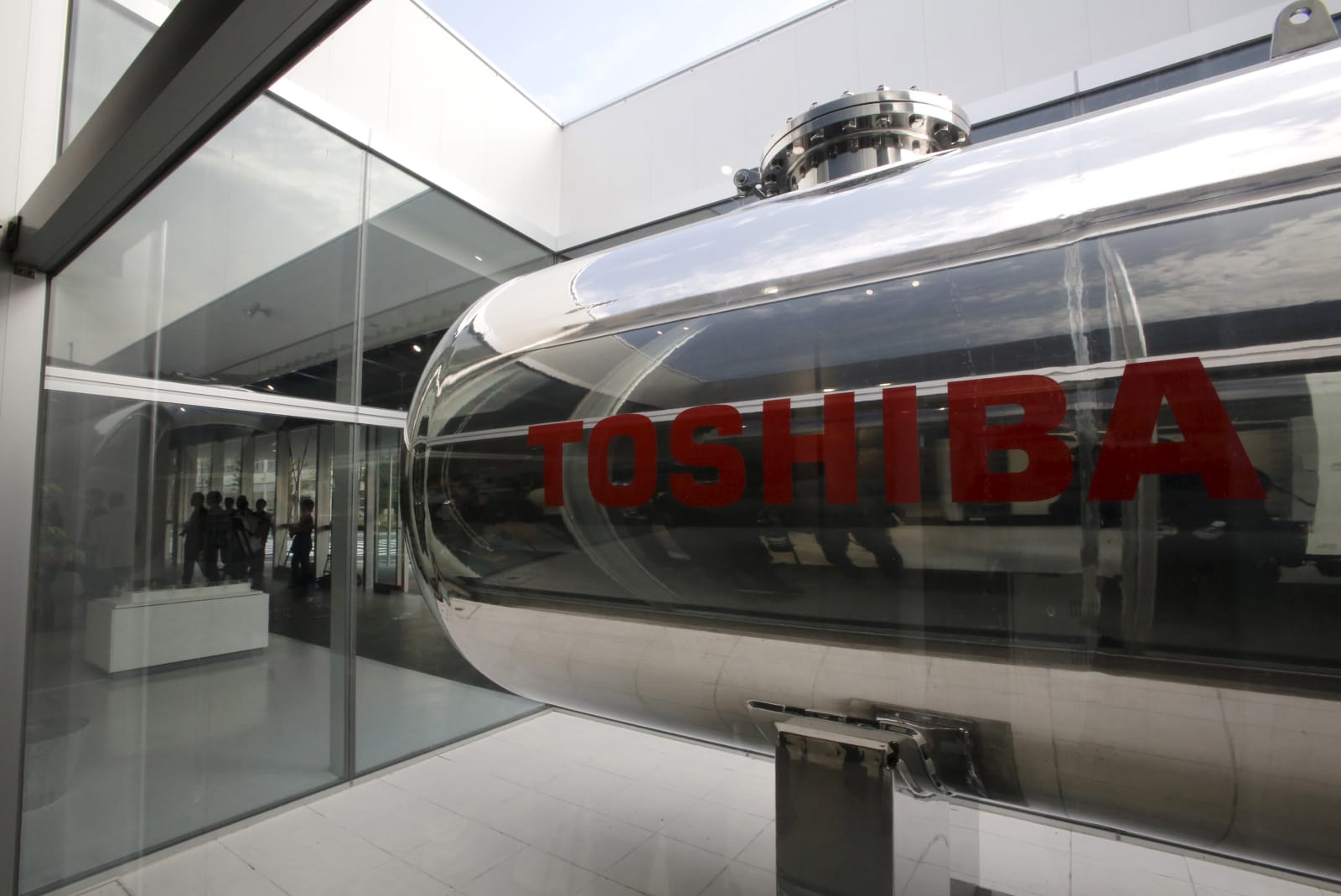
JAPAN-TOSHIBA/
Toru Hanai/Reuters
Toshiba recently unveiled Japan's largest water electrolysis hydrogen production plant (above) that uses power from the electrical grid. Unfortunately the nation still gets most of its electricity from fossil fuels, not renewable or nuclear energy. And the bulk of hydrogen is still produced by methane reforming, a polluting process made worse by the fact that Japan imports its methane.

However, the nation plans to produce more hydrogen by electrolysis over the next decade as part of Prime Minister Shinzo Abe's push to a hydrogen future. For more on fuel cells and hydrogen vehicles, check Engadget's explainer.


Source: Toyota


Read More »

All Tesla cars built from today on have all hardware needed for full self-driving


 Elon Musk revealed the Model 3 in March, revealing details of the $35,000 base model including a sub-six second 0-60 time and a minimum 215 mile range. The basic picture of the Model 3 inspired a pre-order frenzy unlike anything seen previously in the car world, but now Musk has dropped what he referred to earlier as Part 2 of the Model 3 unveiling after a lengthy pause, as promised, and it’s a doozy.

Musk announced that all Tesla cars being produced as of today, including the Model 3, will have everything they need onboard to achieve full Level 5 self-driving in the future. The news means that every Tesla vehicle, including the Model S and X as well as Model 3 cars made after today will eventually be able to achieve full autonomous driving, with what Tesla refers to as “a safety level substantially greater than that of a human driver” via nothing more than a software update at some point in the future.

The hardware required to make this possible includes a sensor loadout complete with eight surround optical cameras, which can see up to 250 meters out from the vehicle on all sides, and a dozen ultrasonic sensors to assist the optical system. These are capable of twice the range of previous hardware, and can detect both “hard and soft objects” according to the company. Also included is the radar hardware that provides forward-facing detection of hazards even through potentially obfuscating conditions.

The biggest change might be the new onboard computer that provides over 40 times the processing power of the existing Tesla hardware, which actually runs the in-house neural net the car maker has developed in order to handle processing of data inbound from the vision, sonar and radar systems. Musk said on call discussing the most recent update to the existing driver assistance Autopilot software that it basically stretched computing power to the limit, which is why the upgraded CPU is required for full Level 5 autonomy. The new GPU is the Nvidia Titan, Musk said on the call, though it was a “tight call” between Nvidia and AMD.

The validation required for full autonomy will still take some more time, but Musk said on a call that it’s actually already looking like it’ll be at least two times as safe as human driving based on existing testing.

While it’s being developed, the self-driving system will operate in the background in “shadow mode,” essentially working virtually behind the scenes in order to demonstrate where it would’ve been able to avoid accidents that a person driving could not.

While the hardware will be included in all Tesla cars made from now on, which includes the Model 3, it will be an $8,000 add-on for vehicles to enable the software.

The reason for building in full autonomy capability across the lineup, according to Musk, is entirely to increase driving safety and reduce traffic-related accidents. Musk spoke passionately about this aim going so far as to admonish broad media coverage of Autopilot-related accidents, while the ongoing and persistent issue of human-fault car deaths receives far less attention from press.

In fact, the National Highway Traffic Safety Administration reported sharp increases in traffic deaths in both 2015 and 2016, and asked for help parsing the data to determine the causes of the rise. And when the Department of Transportation released its federal guidelines for autonomous driving technology, it also strongly indicated that the government believes autonomy in vehicles will ultimately lead to safer roads.

Musk said in a conference call in August regarding Tesla’s advancements in creating a car with Level 4 autonomous capability that “what we’ve got will blow people’s minds, it blows my mind,” and added that “it’ll come sooner than people think.” He’s certainly delivered with today’s announcement.


Read More »

COMPLETE REVIEW OF 2017 Audi Q7

Audi's newest and biggest SUV is the company's technology calling card.

The premium car market has changed quite a bit in recent years. The luxobarge has been toppled from its throne, and there's a new king in town: the big crossover SUV. People are actually buying them—most companies playing in this segment are reporting big year-on-year growth. These four-wheeled flagships get packed full of the latest and greatest technologies their makers have to offer, and if they succeed in the showroom, that shine (and that technology) trickles down to cheaper models. That makes Audi's latest Q7 a very important vehicle for the German car maker.

And packed full of technology it is. There's our favorite digital dashboard, the Virtual Cockpit, an HD affair that fills the binnacle with a Google map running at 60fps thanks to one of NVIDIA's Tegra 3 processors. And there's a suite of sensors and advanced driver assistance systems (ADAS) that are among the best on offer in 2016. But on top of being a tech-fest, the Q7 is also extremely practical; it seats seven and swallows luggage with nary a peep of automotive indigestion.

Right now, there's only one engine to choose from if you're here in the US, a 3.0L TSFI unit. It's a 90-degree V6, with a twin-piston Roots supercharger nestled between the cylinder banks. As you'd expect for a company that pioneered the tech at Le Mans, it uses direct injection, with a relatively high 10.8:1 compression ratio. The headline figures are 333hp (245kW) and 325lb-ft (440Nm), more than sufficient to move the Q7's 4,938 pounds (2,240kg). That power and torque is sent to all four wheels via an eight-speed tiptronic gearbox, which does the 0-60mph on-ramp grand prix in a hot hatch-worthy 5.7 seconds.

There's the usual array of drive modes, including an off-road setting—with the optional air suspension, the Q7 will also lift itself up 2.3 inches (60mm) to clear rough ground at up to 25mph. The rear suspension also drops in conjunction with the rear hatch opening, making it easier getting things in and out of that cavernous cargo space. The second and third rows of seats each move every which way (with power assistance), folding flat, and in the case of the middle row, folding forward as well.

From behind the wheel—ensconced in a jet-black cabin that feels like Darth Vader's staff car, but in a good way—there's no disguising that the Q7 is a large vehicle. But its control weights are good and the ergonomics are spot-on; the gear selector acts as the perfect wrist-rest for your right hand to operate the MMI interface via a scroll wheel and trackpad. But most everything can be done via the multifunction steering wheel. 

The UI is now common across Audi's latest cars, but it's quite intuitive even for newbies.
Although there's a Dynamic mode for the engine and suspension, unlike the BMW X5 or even the Volvo XC90 T6, the Q7 is not really a vehicle you want to rush around. Instead, leave things in comfort and waft everywhere on the engine's wide torque band. Whether driving in the city or the freeway, the Q7's ADAS suite has your back. There's traffic jam assist for rush hour, and tailbacks and adaptive cruise control with lane keeping work extremely well on the open road. Six-hour road trips can feel like popping out to the shops with the big Audi helping to take the strain.

Our test Q7 happily coped with the task of conveying us—and a cargo load of camping equipment—up to Watkins Glen and back for a long weekend. And thanks to an alignment of the stars, Eric Bangeman also put the Q7's people-carrying abilities to the test in the wilds of Colorado.
His thoughts:
After flying into Denver, we were met with an absence of SUVs and minivans available in the self-checkout aisle at National Car Rental. Traveling with my family, this was a problem; we had four suitcases, my golf clubs, and plans to transport the four of us and my parents! I spotted an Audi Q7 in the luxury vehicle section, loaded our baggage, and drove off in it for the same price as midsize vehicle (thanks, Emerald Club).
I’m no stranger to the crossover game, as one of our daily drivers is a 2008 Chrysler Pacifica Limited. In addition to being the most reliable car I’ve ever owned—two of those having been Alfa Romeo Spiders—it’s a great family car. With the third row of seats folded down, there’s plenty of cargo space for cross-country road trips. And when we need room for six, my 16-year-old daughter and 12-year-old son can sit in the third row with no legroom problems.
I’m going to focus on the Q7 as a family car. Similar to other crossovers, the Audi offers a third row of seats which fold up or down with the touch of a button. The middle row seats three, although our daughter reported that the center seat suffers from a lack of legroom thanks to the transmission tunnel. That seat does fold down, however, leaving the middle seats in a bucket configuration and offering plenty of room for a set of golf clubs. The middle seats can be moved back and forward to create more legroom for the unfortunates in the back row, but the kids reported that—even in the best-case scenario—legroom back there was still tight.
There’s not much cargo room left once the third row of seats is populated with humans. You could fit a few bags of groceries or a couple of duffel bags back there, but whatever is left was enough for a day trip to the hot springs at Mount Princeton and Salida, Colorado. With the six of us belted in, we were also able to pack towels, bathing suits, snacks, a change of clothes, and even four water noodles.
Although I drove the Q7 deep into the Colorado Rockies, I didn’t test it on twisty, rutted mountain roads. Instead, I stuck to US Highway 285 through Bailey and Fairplay (the view of South Park from Kenosha Pass is truly breathtaking) and Colorado Highway 291. Those roads are all two or four lanes, nicely paved, and utterly lacking in switchbacks or super-steep grades. I did encounter a couple of stretches of 7 percent (or so) grades and appreciated the manual shifting option as I descended them.
The Q7s TSFI supercharged engine happily answered all of the questions asked of it during climbs, with no problems overtaking slower cars on the long straightaways of US 285 in South Park and the Arkansas River valley
My rental was missing the bells and whistles available, including the traffic jam assist and adaptive cruise control. It did come with blind spot indicators, although I never entirely got used to seeing them flash. That said, reminders to always (ALWAYS) check your blind spots before passing are welcome.
The striking thing about the Q7 is how quiet it was, even at speed on a busy highway. Outside traffic sounds were mere suggestions, no matter how rough the road or how many cars I was sharing the road with.
Although Eric enjoyed the Q7's UI and rapidly became au fait with it (as well as Apple CarPlay), his car sadly didn't come with some of the better bells and whistles of the Q7 range. That highlights one possible issue with the großer-Audi; while the base price is a class-competitive $54,800, you need to spend roughly $10,000 more to get the Virtual Cockpit and ADAS goodies (either by opting for the Premium Plus version and speccing the Driver Assistance and Vision packages or getting the range-topping Prestige version). It's still a good vehicle without those goodies, but this is Ars Technica—if you're reading this, you probably have a healthy interest in the digital.

Our main issue with the Q7 is down to that sole choice of engine. After several hundred miles in the Q7, we averaged 23.8mpg. That's better than our results in either the BMW (which was a hybrid, no less) or the Volvo, which should be a feather in Audi's cap. But there's another engine in Audi's quiver, one that surely makes much more sense in this role—or would have done, had Volkswagen not been caught lying about emissions. You see, the 3.0L TDI diesel (which makes up the bulk of Q7 orders in Europe) is barely any slower than the gasoline-powered TSFI version yet offers almost double the fuel mileage: over 40mpg. Here's hoping VW Group gets its diesel fix together soon because that engine in this SUV would make for a potent combination.

Source:Jonathan Gitlin and Eric Bangeman
Read More »

Latest In The World Of Car Technology Is BMW VISION NEXT 100

Where does BMW see its four brands in a future where the cars drive themselves? 


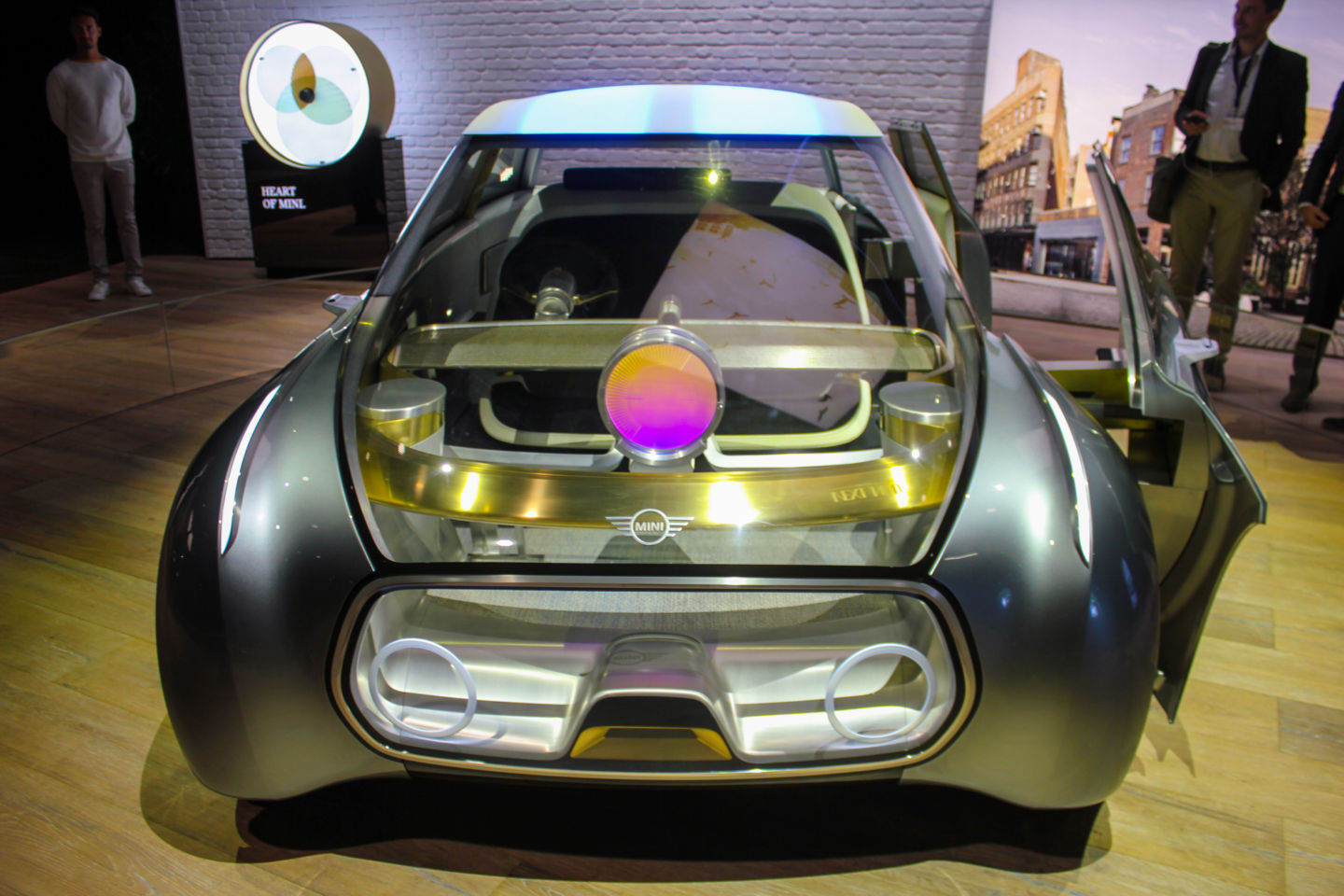
SANTA MONICA, Calif.—On Tuesday, BMW showed off its four new concept cars under one roof together for the first time. These cars included not only the new BMW Motorrad Vision Next 100, but also a new futuristic Rolls-Royce, Mini Cooper, and BMW. Each shows us that marque's view of its place in a world where our vehicles are intelligent and drive themselves, which some see as an existential threat to companies, like BMW, that have made their reputations by focusing on driver engagement.

The star of the show, which took place in the Santa Monica Airport's Barker Hanger, was BMW's new motorcycle, which combines previous models revealed in Munich, London, and Beijing. The concepts also build on ideas that BMW showed us at CES in January, notably the triangle-based UI for the BMW VISION NEXT 100, as well as the way its seats move and cant together when in self-driving mode.


After some experiments with augmented reality, BMW's chief designer, Adrian van Hooydonk, thinks those full-screen heads-up displays some of us have been dreaming about will actually make it into our cars before too long.

"Today we already have a heads-up display in most of our BMWs. It's projected onto the windscreen, but you experience it like it's augmented reality. But we're working on technology that can improve the display area, making it larger, and eventually we envision that the whole windscreen will become a projection area," he told Ars. An exact timeline is dependent on the company's suppliers, but van Hooydonk thought that "within one to two vehicle generations the system will be ready for production."


The collection of BMW VISION NEXT 100 concepts is on display at the Barker Hangar in Santa Monica, California, and is free and open to the public until October 16.
Listing image by Cyrus Farivar


 Source

Read More »

The Wolrd First 3D-Printed Car Finally Unleashed


Finally, after over 1-year in production, the prototype has now been equipped with a functional drivetrain. 

 Created by Divergent Microfactories, the "Blade" is touted as the world's first 3D-printed supercar, and most certainly won't be the last. Everything from its aluminum joints that connect pieces of carbon fiber tubing to the body panels, has been 3D-printed. Under the hood, you'll find a 700-horsepower bi-fuel engine capable of running on compressed natural gas or petrol, which supposedly propels the 1,400-pound vehicle from 0-60mph in just 2.2-seconds. Click here to view the first image in today's viral picture gallery. Continue reading for the five most popular viral videos today, including one of of Grand Theft Auto V in real-life.

Read More »

Six Tremendious Car Technologies That Are reshaping Motoring Security for the Better


Right now it feels like driving a car could not possibly get any better. Manufacturers are in constant competition to create a car that speaks to the consumer of today. Using innovative built-in features, mini computers and optional extra’s that all appeal to a new generation of tech-minded car buyers, the automotive industry has never looked better.

Most petrol heads will undoubtedly argue that this technology has changed the motoring industry for the better, new car sales at are at a high in the UK, and they just keep growing. Maps have become all but archaic documents that tell a tale of roads that once were whilst we are now guided by satellite navigation to our destination. These same devices are even about to be used by driving schools in UK driving tests, as examiners feel that the testing procedure should be more on course for the way that we drive on the roads today.

The question that must be asked, of course, is: “has car technology improved our motoring habits for the better”? Are we a safer nation of drivers with all of this technological advancement around us? I’m going to take a brief look at some of the more popular technologies out there and review how, or if, they really are improving safety on our roads.

1.      Vehicular Communication Systems (V2V)

V2V technology is a system which has been designed to transmit basic safety information between passing vehicles. This technology helps to assist drivers by warning them of impending car crashes. Its been about for over 10 years in one form or another, however there are still a significant number of crashes on the road as this technology has been slow to become popular. This could easily be addressed in the future through a more expanded use and further advanced crash avoidance technologies.

2.      GPS Vehicle Tracking

With a combination of GPS and on-board diagnostics, a car can map and record exactly where it is, how fast it’s traveling and how it’s performing. The GPS tracking device is most usually hardwired to the inside of the vehicle, connected to the ignition switch, battery and antennae.

Vehicle tracking technology has become most popular amongst fleet operators, hauling and logistics companies because its primary uses are to track a vehicle and monitor driving events. So if a vehicle is stolen, with the aid of a mobile tracking device, police cars can often pinpoint an exact location, even if the car happens to be hidden in a garage somewhere hundreds of miles away.

3.       In-Car Camera’s


In the event of a motoring accident, most of us are often hesitant to admit guilt and willingly give up our no claims bonus. However, with the use of this increasingly popular car technology, it begins to become more apparent to everyone involved who was at fault. Because of this, more motorists than ever before are considering popular in-car camera options in an effort to combat illegitimate claims made against them, by people such as “crash for cash” fraudsters.


4.      Self-Driving Cars


Self-Driving cars involve use of autonomous technology within (mainly) electric vehicles. Google have become to be known as the pioneers of driver less cars, unveiling their first prototype in May 2014. The battery has a range of about 100 miles and the car uses a combination of technology such as; GPS, radar, lasers and cameras to monitor everything happening around the vehicle. The software (named ‘Google Chauffeur’) is capable of recognizing road markings, road signs, traffic lights and even pedestrians. It can even detect hazards in the road and maneuver safely around them. Google are not the only company working on this technology though, Tesla also have and they stated that although achieving 99% success was easy, they needed to achieve 99.9999%. A hacker named George Hotz has also been locked away for a couple of years working on his autonomous driving project, Comma.ai.

That’s not to say that self-driving cars haven’t had their fare share of shortcomings either though. One current major problem being that the Department of Motor Vehicles, in the USA, are having trouble deciding how to test self-driving vehicles for certification on public roads.


5.      Rear Mounted Radar

 If you have ever backed your car into a pole, another car, a person or just about any other obstacle often discovered hovering around the rear of your vehicle when reversing, then you’ll understand why rear-mounted radar technology has become as popular as it has in recent years. So popular, that most car manufacturers have a rear-mounted radar built-in to the vehicle. This simple technology works by scanning the area directly behind the car and giving you an alert, or if you have a dashboard monitor, an image. The radars can also detect traffic approaching the rear of your vehicle, and if you are reversing, it will sound an alert to warn you of an impending collision.

6.      Airbags That Stop Cars
Ever since the first airbags were manufactured for vehicles circa 1994, they have slowly moved themselves around our cars like an overly large fidgety child trying to get comfortable in its own skin. We have dashboard airbags, side airbags, knee airbags, and even air bags for seat-belts. Now a newly developed motoring safety technology, that should be with us by the end of the decade, is external airbags.

This technology works by deploying under the front of the car just milliseconds before a collision, this acts an anchor by rubbing along the road. The friction generated causes the braking power of the vehicle to double. It also raises the car by approximately 8-10 centimeters, which in turn, improves the effectiveness of seat-belts by helping to stop people from sliding under them during a head-on collision.

So, it appears that as this slew of progressive technology encroaches into our daily driving habits, it is certainly making a difference to the way that we drive. There have been vast improvements in motoring safety, not just on the public roads but also in motorsport, and this technology has a hand in achieving that. Although, the testing and regulation of motoring technology is something that needs keen focus moving forward if we are to continue to develop gadgets that robotically interact with our human responses.

In short, today’s ‘cutting edge’ is tomorrow’s ‘commonplace’ and we shouldn’t be concerned about this at all.
Read More »